

Best Boutique Guitar Shops 2026: Top Custom & Vintage Picks

Table of Contents
- What Makes a Boutique Guitar Shop Worth Your Time in 2026
- Quick Comparison: Boutique Electric Guitars for Sale in 2026
- Custom Guitar Shops: How Authorized Dealers Get You Access to Builders
- Vintage Guitar Shops and the Value of a Rotating Gallery
- Used Guitar Stores Near Me: Why Local Beats Online for High-End Gear
- Tonewoods, Hardware, and Craftsmanship: What Actually Drives Price
- How to Evaluate Any Boutique Guitar Shop Before You Buy
- Frequently Asked Questions
Last Updated: October 12, 2026
What Makes a Boutique Guitar Shop Worth Your Time in 2026
A boutique guitar shop is an independent retailer specializing in handcrafted, small-batch, and vintage instruments rather than mass-produced catalog stock.
The core tension in 2026: most players begin their search online, yet the instruments that hold value are the ones you need to hold first.
Below: how to judge any boutique shop, what separates custom builds from used finds, and why tonewoods and hardware matter.
NAMM's industry research on musical instrument retail trends
Quick Comparison: Boutique Electric Guitars for Sale in 2026
Here's a snapshot of what sits in a well-curated boutique inventory right now, with real prices and the player each build suits.
| Guitar | Price | Build | Best For |
|---|---|---|---|
| Sugi Rainmaker | $2,450 | Roasted alder, USA-built | Versatile gigging players |
| K-Line 50's Truxton | $2,950 | Ash body, relic finish | Classic T-style tone chasers |
| K-Line Truxton Thinline | $3,050 | Mahogany thinline | Studio and stage warmth |
| Harvester Marquee | $3,350 | Queensland Maple offset | Offset fans wanting modern stability |
| Harvester DC6 Deluxe | $3,450 | Australian tonewoods | Players chasing articulate humbucker tone |
| Grez Mendocino F | $3,900 | Semi-hollow, burst top | Jazz and P90-style midrange |
| Tausch 665 RAW DeLuxe | $4,295 | Chambered pearwood | Blues to modern rock |
| Lumière Thinline T | $4,649 | Spanish cedar, hand-built | Touch-sensitive phrasing |
| MADA Tesffo | $4,750 | Elm body, P90s | Players wanting something distinct |
| Brondel Honeycaster | $5,000 | Alder, Ron Ellis pickups | T- and S-style hybrid seekers |
Two patterns stand out. The spread between a $2,450 Sugi Rainmaker and a $5,000 Brondel Honeycaster reflects materials, pickup quality, and builder reputation, not marketing. And every instrument comes from a named luthier or small shop, that accountability is the point of buying boutique.

Custom Guitar Shops: How Authorized Dealers Get You Access to Builders
The best custom guitar shops do what a direct-to-consumer builder often can't: put a finished example in your hands before you order.
Take the Brondel Honeycaster Hybrid at $5,000.
Working through a dealer also gives you a paper trail. A builder like Adam Wehsely-Swiczinsky, who hand-builds the MADA Tesffo in Vienna, produces limited numbers; a dealer who stocks his work can explain wait times, finish options, and what a deposit commits you to.
Vintage Guitar Shops and the Value of a Rotating Gallery
A rotating gallery is the best argument for shopping vintage in person. Vintage and used instruments are one-of-one, so a shop that turns its floor regularly surfaces instruments a fixed keyword search never would. That's why a dated, 2026-verified guide beats an evergreen directory: last year's accurate inventory is often gone this year.
How condition grading actually works
Most reputable shops grade used and vintage instruments on a simple scale, and you should ask any shop to state its grade in writing before you buy:
- Mint, no visible wear, original parts, minimal play time.
- Excellent, light play wear, no structural issues, original or period-correct parts.
- Very Good, visible finish wear, small dings, fully playable, may have replaced wear items like frets or a nut.
A shop that plays every instrument, notes fret wear, checks the truss rod, and discloses replacements does work an anonymous listing can't. Ask: Has it been refretted? Is the finish original? Are the pickups original? Has the neck ever been reset? Those four questions separate a graded instrument from a guess.
Authentication and the paper trail
For anything claiming vintage status, the paper trail matters as much as the guitar. A specialist shop documents the serial number, year of manufacture, and provenance such as a sales receipt, builder's letter, or prior owner history. For mass-produced vintage models, serial numbers and date codes on pots and pickups are the standard check; for luthier-built instruments, the builder's records are the reference.
Trade-ins, consignment, and how shops price vintage
Rotating inventory doesn't happen by accident. Shops keep it moving through three channels:
- Direct purchase, the shop buys the instrument outright, usually at a wholesale percentage of its resale value, and takes on the risk.
- Trade-in, you apply credit from an instrument you bring toward one on the floor; the shop sets the trade value, and you can often negotiate the difference.
- Consignment, the shop sells on your behalf for a commission, commonly in the range of 15 to 30 percent, and you keep the rest once it sells.
Knowing which channel a shop uses tells you how it prices. A shop that buys outright needs margin for risk and setup; a consignment shop can price closer to market because the owner carries the risk. Neither is wrong, they just change what you should expect to pay and how much room there is to negotiate.
Why the gallery rotation is your advantage
Rotating inventory also changes how you shop. Hunting a specific vintage spec? Tell the shop and ask to be contacted when something close arrives. Ask how often the floor turns over, whether they hold instruments on deposit, and whether they'll send a video demo before you make the trip.
Reverb's annual used gear market report
Used Guitar Stores Near Me: Why Local Beats Online for High-End Gear
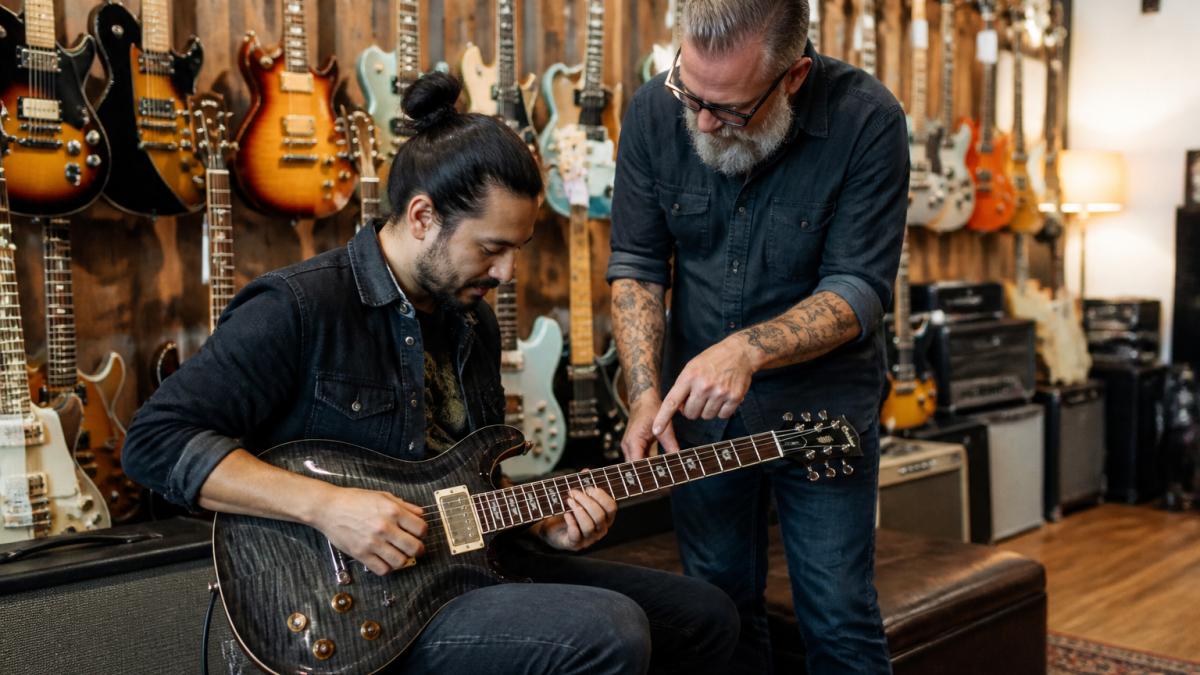
Search "used guitar stores near me" and you'll get a map of options, but not which ones understand high-end gear, and no help if the right instrument is three states away.
The comparison criteria that actually matter
When you shortlist a boutique shop, in person or online, compare it on the same six axes rather than on vibe:
- Focus, acoustic, electric, or both; vintage-heavy or new-builder-heavy.
- Inventory type, new custom builds, used, vintage, or a mix.
- Price range, where the floor starts and where it tops out.
A shop that scores well on all six is worth a trip. One that scores well on focus and inventory but poorly on policies is worth buying from only after you've verified return terms in writing.
Brondel Honeycaster Hybrid - Fiesta Red w/ Ron Ellis pickups (Authorized Dealer) →
Services beyond sales
The practical details are where shops separate. Ask each one:
- Do they do a full setup before shipping, and is it included?
- Do they accept trade-ins, and how do they value them?
- Do they offer consignment, and at what commission?
A shop that services what it sells has a reason to sell you the right instrument the first time; a drop-shipper doesn't.
Buying remotely without getting burned
If you can't visit, the protections you negotiate up front are the whole game:
- Remote demos, ask for a video or live call playing the actual instrument, not a stock clip.
- Condition grading, get the grade and the list of replaced parts in writing before payment.
- Shipping insurance, confirm the instrument is insured for its full value in transit and who files the claim if it arrives damaged.
Pay with a method that gives you a dispute process, and keep the listing, condition statement, and messages in one place. If a seller won't put condition and return terms in writing, that's your answer.
Why local still wins when it can
Three things happen in person that can't through a listing. You hear the instrument through your own amp or a comparable one.
The Grez Mendocino F proves the point. At $3,900, it's a lightweight semi-hollow with a burst top, Righteous Sound Bishop pickups, and a soft V neck measuring .89 inches at the first fret.

Local also means service after the sale: setup, string changes, and adjustments you can drive to.
Tonewoods, Hardware, and Craftsmanship: What Actually Drives Price
Price in the boutique market tracks three things: the wood, the hardware, and the hours a human spent building the instrument. Everything else is decoration.
Start with tonewoods. The Harvester DC6 Deluxe, at $3,450, pairs a Queensland Maple body with a figured U.S.

Hardware is the second lever. The Tausch 665 RAW DeLuxe at $4,295 runs Sperzel locking tuners, a bone nut, and a Vint Tremolo with a wooden sustain block.
Craftsmanship is the third and hardest to fake.
How to Evaluate Any Boutique Guitar Shop Before You Buy
Use this checklist before committing to any shop, in person or online.
- Does the shop carry real inventory from named builders, or only order-on-demand listings?
- Can staff tell you the neck profile, weight, and pickup specs from memory?
- Will they let you play through your own rig or a comparable amp?
U.S. Federal Trade Commission guidance on buying and warranties
The hardest part of buying a boutique instrument isn't finding one, it's finding a shop that knows the difference between the guitars it stocks and can prove it in person. South Shore Guitar Boutique is an authorized dealer for the builders we carry, with a rotating gallery of handcrafted and vintage instruments and custom order assistance for players who want something built to their spec.
Frequently Asked Questions
What should I look for in a boutique guitar shop?
Start with authorized dealer status for the builders you care about, since that determines whether custom orders and warranty support are handled directly. Then check inventory depth: a shop carrying hand-built instruments from multiple countries shows broader buying relationships. Ask about setup and service after the sale, and look for a return or exchange policy that covers in-store purchases. Finally, confirm the shop actually keeps a rotating gallery rather than a static wall, because fresh inventory signals an active dealer network.
Are boutique guitar shops worth the higher prices?
The price gap reflects labor, materials, and scale. A hand-built instrument like the Brondel Honeycaster at $5,000 uses Ron Ellis pickups, a bone nut, and Jescar fretwire, and it is assembled by one luthier in Maine rather than on a production line. You are also paying for setup, warranty handling, and access to builders who do not sell direct. If you play regularly and want an instrument that holds value, that premium is often recoverable at resale.
Can boutique guitar shops help with custom orders?
Yes, and this is where authorized dealers earn their keep. A shop with direct builder relationships can place a custom order, relay your spec sheet accurately, and act as your point of contact if anything needs adjusting. The process usually starts with a consultation on body wood, neck carve, pickups, and finish, followed by a deposit and a build timeline. Ask for the builder's lead time in writing before you commit, and confirm who handles shipping and any warranty claims.
Where can I find rare or vintage guitars?
Independent shops with rotating inventory are the most reliable source. South Shore Guitar Boutique, for example, keeps a curated gallery of boutique and vintage guitars, amplifiers, and effects pedals rather than a fixed catalog. Store demo and prior-year instruments such as the Tausch 665 Raw DeLuxe at $4,295 appear alongside new builds, which gives you a chance to inspect condition in person. Always ask for serial numbers, weight, and any prior repair history before buying.
How do I avoid hidden damage when buying a used guitar?
Inspect in person whenever possible. Check the neck for twist by sighting down the fretboard from the headstock, test every fret for buzz, and look inside the soundhole or control cavity for signs of water damage or amateur rewiring. Ask whether the instrument has had a refret, a headstock repair, or a pickup swap. Reputable shops disclose this upfront and provide a written condition summary. If you buy remotely, request a video walkthrough and confirm the return window before paying.
Leave a comment