

Are Boutique Guitars Worth It? A 2026 Review

Table of Contents
- What Actually Separates a Boutique Guitar From a Production Model
- Boutique vs Mass-Produced Guitars: Where the Real Differences Show Up
- The Best Boutique Guitar Brands and What Their Instruments Actually Deliver
- Boutique Guitar Resale Value: What the Market Really Pays
- Total Cost of Ownership: Price Premium, Setup, and Long-Term Value
- Who Should Buy a Boutique Guitar (And Who Shouldn't)
- Frequently Asked Questions
Last Updated: October 14, 2026
What Actually Separates a Boutique Guitar From a Production Model
A boutique guitar is a hand-built instrument produced in small numbers by an individual luthier or a small workshop, where the builder makes the key decisions about wood, hardware, and final voicing rather than a factory production line. At South Shore Guitar Boutique, we see the difference most clearly in how each instrument gets individual attention at every stage.
Production guitars are built to a spec sheet and a quota. Boutique builds are built to a player.
That distinction matters because it changes what you're actually paying for. Not just a name or a finish, but time, judgment, and the freedom to build outside a standard template.
Hand-Built Construction and Individual Attention
A production guitar moves through stations. One person cuts necks, another sets frets, another wires electronics. Consistency comes from process control, and modern factories have gotten very good at it. A forum discussion on the Kemper Profiler Forum notes that mass-produced instruments today are far more consistent than instruments built in the 1950s, and that's a fair point.
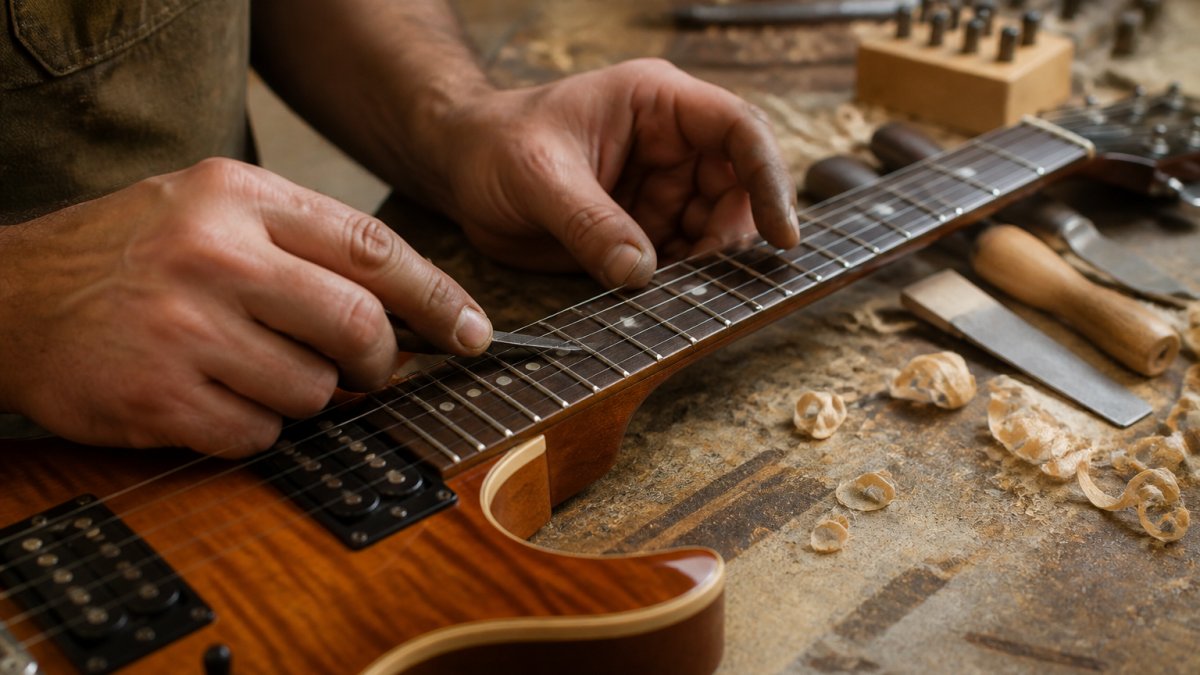
A boutique builder works differently. One set of hands carries the instrument from raw wood to final setup. That builder feels the neck as it takes shape, adjusts the carve, and voices the pickups against the specific piece of wood in front of them. The Novo Serus J Custom we carry shows this clearly: a tempered pine body, tempered maple neck, and a .880-inch Chunky C profile.

The tradeoff is time. You cannot rush a build like that, and you cannot scale it.
Wood Selection and Component Upgrades
Boutique builders choose wood by the board, not by the pallet. A luthier taps, weighs, and matches tops to bodies before committing to a build. The Knaggs Kenai T.O.M. pairs a Tier 2 maple top with a mahogany body for warmth and articulation, and that pairing is a deliberate decision, not a default.
Components follow the same logic. Lollar Imperial humbuckers in the Kenai, Ron Ellis Signature humbuckers in the Brondel Burn II, Lollar P-90s in the Novo. These are named pickups chosen for a specific voice, not generic units pulled from a bin.
Hardware gets the same treatment: Mastery M1 bridges, TonePros T.O.M. bridges, Gotoh SD91 tuners, bone nuts. Small upgrades individually. Together they change how the instrument feels and responds.
Boutique vs Mass-Produced Guitars: Where the Real Differences Show Up
The honest answer is that boutique vs mass-produced guitars is not a quality contest anymore. Modern production guitars are reliable, well-built, and gig-ready out of the box. The real differences show up in three places: tone, playability, and setup.
Tone, Playability, and Setup
Tone is the hardest claim to prove and the easiest to oversell. We'll be direct: much of what players describe as "boutique tone" comes from pickup selection, setup, and how the instrument responds to touch, not from some mystical property of expensive wood. A blind test between a well-set-up production guitar and a boutique build at the same price point would produce uncomfortable results for boutique purists.
What boutique builds genuinely offer is tonal complexity at the edges. The Brondel Burn II is built light, with a thinner body than a traditional single cut, and that construction changes how the instrument resonates and sustains. You feel it before you hear it.
Playability is where the money shows up more reliably. Compare the numbers:
| Model | Neck Profile | Price |
|---|---|---|
| Novo Serus J Custom | .880" Chunky C | $4,399 |
| Knaggs Kenai T.O.M. | C with slight V | $5,700 |
| Brondel Burn II | .846"-.931" | $6,800 |
| K-Line 50's Truxton | .850" C | $2,950 |
| Huss & Dalton Tom-M | OM profile | $5,465 |
Look at the Brondel's neck depth: .846 inches at the first fret.931 at the twelfth.

Setup is the quiet advantage. Every instrument we sell gets checked before it leaves the shop.
The Best Boutique Guitar Brands and What Their Instruments Actually Deliver
The best boutique guitar brands are the ones with a consistent voice and a builder who stands behind the work. Here's what the instruments we carry actually deliver, in plain terms.
Novo Serus J Custom ($4,399) is our pick for players who want expressive P-90 tones with a broken-in feel from day one. The light distress and Gold Plexi pickguard give it character without looking abused.
Knaggs Kenai T.O.M. ($5,700) suits players who want a familiar single-cut feel with distinctive details. The maple top over mahogany delivers warmth and depth, and the Lollar Imperial humbuckers stay clear under gain.
Brondel Burn II ($6,800) is the most refined instrument in the group. Built one at a time by Laurent Brondel in rural Maine, it takes the Les Paul foundation and makes it lighter, thinner, and more elegant.

K-Line 50's Truxton ($2,950) is the value entry into hand-built territory. Chris Kroenlein's take on the classic single cut delivers punch, clarity, and dynamic response, with K-Line Signature T pickups covering everything from percussive cleans to dynamic overdrive.
Huss & Dalton Tom-M Custom ($5,465) is for acoustic players who want an Orchestra Model with clear fundamentals. Handcrafted in Staunton, Virginia, it pairs spruce and mahogany with scalloped bracing for immediate attack and broad dynamic control.
Novo Serus J Custom — Ice Blue Metallic - (Authorized Dealer) →
Boutique Guitar Resale Value: What the Market Really Pays
Here's the part most buying guides skip: boutique guitar resale value is inconsistent, and anyone telling you these instruments are safe investments is selling you something.
A Guitar Forum participant on The Gear Page noted that boutique guitars can sell for a fraction of their original price because they lack the resale recognition of Fender, Gibson, or PRS. A name that means everything to forty serious players may mean nothing to the broader used market.
Mass-produced guitars from major brands hold value because there's a deep, liquid market for them. Buyers know what they're getting. Boutique builds trade that liquidity for individuality, and that's the deal.
If appreciation is your goal, buy vintage from an established brand. If you want an instrument that fits you specifically, buy boutique and accept that resale is a secondary concern.
Total Cost of Ownership: Price Premium, Setup, and Long-Term Value
The purchase price is only the first number. Total cost of ownership for a boutique guitar includes the instrument, a professional setup, ongoing maintenance, and the depreciation you'll absorb if you sell.
The price premium over a production guitar is real and substantial. A hand-built instrument costs more because it takes more hours, uses selected materials, and comes from a builder who isn't spreading overhead across thousands of units.
Where the math shifts is longevity. A well-built guitar with a proper setup and stable construction can serve a player for decades. Frets wear and get replaced. Electronics get serviced. Necks stay true.
Setup costs recur. Every guitar needs adjustment as seasons change and humidity shifts. Budget for at least one professional setup in the first year and periodic attention after that. The Huss & Dalton includes a molded hard case, which protects the instrument during transport and storage, and that matters more than most players realize.
What you're really buying with the premium is fit. A guitar that matches your hand, your ear, and your playing style saves you the cost of buying three instruments trying to find it.
Who Should Buy a Boutique Guitar (And Who Shouldn't)
Buy a boutique guitar if you know what you want and you can feel the difference when you play it. Skip it if you're still figuring out your preferences, or if resale flexibility matters more than fit.
The buyer-specific decision framework we use comes down to four questions:
- Do you know your neck preference? If you can describe the profile and radius you like, a boutique build can match it precisely. If you can't, you're paying for a guess.
- Will you play it enough to justify the premium? A touring or recording musician gets value back every session. A guitar that lives in a case doesn't.
- Do you need resale liquidity? If yes, a production instrument from a major brand is the safer choice.
- Can you test it in person? Boutique guitars vary instrument to instrument, even within the same model. Playing before buying removes the biggest risk.
Working musicians and serious hobbyists with clear preferences get the most from boutique instruments. Collectors seeking rare and limited-edition pieces get access to builders they can't find elsewhere. Beginners and players who change gear frequently are better served by a well-made production guitar.
We also hear from local players who worry a boutique shop will make them feel out of place. It shouldn't. Plenty of our customers just want something reliable for gigs, and the conversation starts with what you actually play, not what you can afford.
On sustainability, we handpick instruments with an emphasis on craftsmanship and environmental responsibility, and we're happy to talk through what a given builder does and doesn't disclose.
On custom orders, the process works like this: we discuss your specifications, confirm what the builder can deliver, place the order, and keep you updated through the build. Lead times vary by builder and can run months. If the finished instrument doesn't match what you imagined, we work through the options with you before delivery.
The hardest part of buying a boutique guitar isn't the price. It's knowing whether a specific instrument fits you, and that answer only comes from playing it.
Frequently Asked Questions
Are boutique guitars better than mass-produced guitars?
Not automatically. Boutique guitars get more individual attention during construction, which often means better fretwork, a more precise setup, and components chosen for that specific instrument. Mass-produced guitars have improved significantly in consistency over the past few decades. The real difference shows up in the details: how the neck feels in your hand, how the pickups respond to your playing, and whether the guitar was set up for you or for a shipping box.
Do boutique guitars sound better?
They sound different, and that difference matters more to some players than others. A hand-wound pickup or a carefully voiced instrument can deliver more harmonic detail and a more immediate response to your touch. But tone is subjective, and a well-built production guitar through a good amp can sound excellent. The honest answer is that boutique guitars give you access to specific tonal character you cannot easily find off the shelf, not a universal upgrade in sound quality.
Are boutique guitars a good investment?
For most buyers, no. Boutique guitar resale value depends heavily on brand recognition, and many small-shop instruments sell for a fraction of their original price on the used market because they lack the name recognition of larger manufacturers. A forum discussion on The Gear Page noted this resale challenge directly. Buy a boutique guitar because you want to play it, not because you expect it to appreciate.
What should you look for when buying a boutique guitar?
Play the instrument before you buy it if possible. Check the fretwork for level crowns and smooth ends, look at the nut slots for proper depth, and play every fret up the neck to check for buzzing or dead spots. Ask about the neck profile measurements, the pickup specifications, and the return policy. If you are ordering custom, get the scale length, nut width, and neck depth confirmed in writing before the build starts.
Can you get boutique-level quality without paying boutique prices?
Sometimes. Smaller builders who do not carry the overhead of a large brand can offer hand-built instruments at lower price points. The K-Line 50's Truxton at $2,950 is a good example of a hand-built guitar with vintage-inspired tone and a relic finish that costs less than many flagship production models. The trade-off is usually brand recognition and resale value, but if you are buying to play, that trade-off can work in your favor.
Leave a comment