



7 Truths About Sustainable Guitar Wood and Tone

Last Updated: November 10, 2026
Quick Summary
No, sustainable guitar wood is not automatically better sounding than conventional tonewood. The evidence is thinner than the marketing suggests, and species, stiffness, density, and how a builder voices a top matter far more than a sustainability label.
- Sustainable tonewoods are harvested and traded to keep supply available long-term, with documented chain of custody.
- A 2023 peer-reviewed study of 14 guitar manufacturers' websites documented sourcing concerns, not acoustic superiority.
- Lancaster University researchers tested six acoustic guitars and found no broad tonal hierarchy.
- Stiffness-to-weight and damping explain much of what players hear, regardless of how wood was grown.
- A sustainable badge with no species, origin, or paperwork is a marketing claim, not proof.
Table of Contents
- The Real Question: Does Sustainable Guitar Wood Sound Better?
- What Sustainable Tonewoods Actually Are
- Traditional Tonewoods vs. Alternative Tonewoods: A Component-by-Component Comparison
- Where a Bamboo Electric Guitar Fits (and Where It Doesn't)
- What the Evidence Says About Sound, Sustain, and Durability
- How to Verify an Eco-Friendly Guitar Claim Before You Buy
- Book a Hands-On Tonewood Consultation
- Frequently Asked Questions
The Real Question: Does Sustainable Guitar Wood Sound Better?
No, sustainable guitar wood is not automatically better sounding than conventional tonewood. The evidence is thinner than the marketing suggests, and most claims either way outrun the data.
Here's what we actually know. A 2023 peer-reviewed study of 14 guitar manufacturers' websites examined how builders describe wood use and sustainability in modern acoustic guitars; it documented sourcing concerns, not acoustic superiority. Lancaster University researchers tested six acoustic guitars for wood-type effects, and the published findings don't establish a broad tonal hierarchy. At South Shore Guitar Boutique, we've watched this debate harden into dogma on both sides, and the honest answer sits in the middle: species, stiffness, density, and how a builder voices a top matter far more than a sustainability label. For the wider cost question, see our review of whether boutique guitars are worth it.
Below, we break down what sustainable tonewoods actually are, how they compare by component, and how to verify a claim before you spend four figures on an eco-friendly guitar.
What Sustainable Tonewoods Actually Are
Sustainable tonewoods are woods harvested and traded in ways intended to keep supply available long-term, with documented chain of custody from forest to builder. The label describes sourcing practice, not sound.
Three categories matter:
- Old-growth wood comes from mature, slow-grown trees, often denser and stiffer stock that builders prize for tops.
- Plantation-grown wood is farmed on managed land for predictable yield and faster regrowth.
- Reclaimed wood is salvaged from fallen trees, retired structures, or submerged logs.
Old-Growth, Plantation-Grown, and Reclaimed Wood
Taylor Guitars notes that traditional acoustic-guitar woods face pressure from rising global consumption, and that reliable data on the global wood trade is genuinely hard to pin down. That uncertainty is why traceability, not the word "sustainable," is the thing to inspect. A sinker mahogany back and sides, like the one on our Huss and Dalton 00-SP Custom, comes from logs submerged decades ago, which is a different supply story than plantation stock.

Traditional Tonewoods vs. Alternative Tonewoods: A Component-by-Component Comparison
The top wood shapes response and projection; back and sides color resonance and depth. Compare by component, not by slogan, and compare on properties you can actually reason about: density, stiffness-to-weight ratio, damping, and dimensional stability.
| Component | Traditional Choice | Alternative Choice | Property That Changes | Practical Trade-Off |
|---|---|---|---|---|
| Top | Sitka spruce, western red cedar | Moon spruce, reclaimed spruce, sinker redwood | Stiffness-to-weight drives attack, headroom, and how hard you can drive the top | Reclaimed and moon spruce can be stiffer and lighter, but supply is inconsistent and grading varies by seller |
| Back and sides | Brazilian rosewood, Honduran mahogany | Claro walnut, sinker mahogany, black locust | Density and damping shift bass depth, midrange focus, and sustain | Walnut and locust are more available and often less expensive; rosewood substitutes vary widely in tap tone |
| Neck | Honduran mahogany | Khaya, maple, roasted maple | Stability and weight, minimal tone effect | Khaya is a common mahogany substitute; roasted maple is stiffer and more stable but heavier |
| Fretboard and bridge | Ebony, rosewood | Richlite, reclaimed ebony, pau ferro | Wear resistance and damping at the contact points | Richlite is dimensionally stable and consistent; ebony and rosewood vary piece to piece |
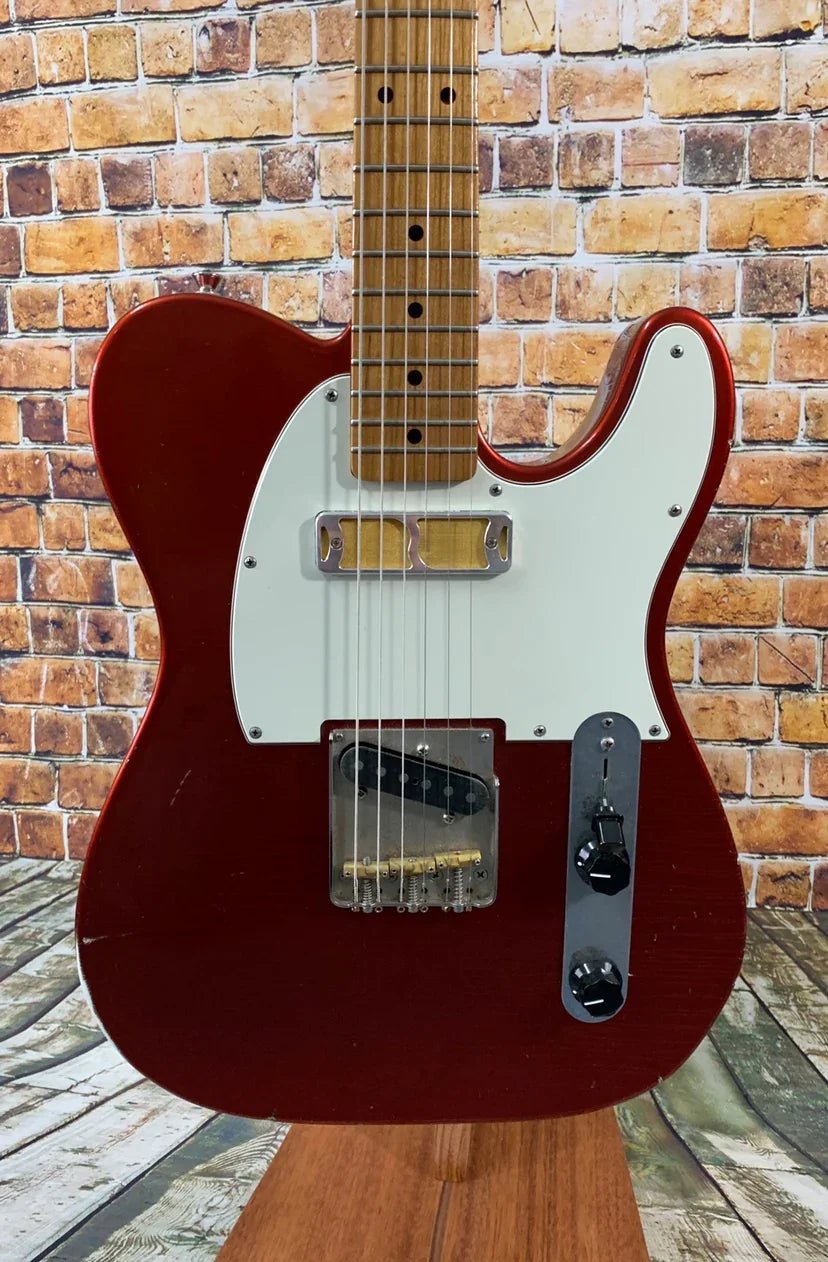
| Body, electric | Alder, ash | Mahogany, basswood, paulownia | Resonance and midrange warmth | Lighter bodies balance better but can shift perceived attack; pickups still dominate the signal |
A Western Red Cedar top over Claro Walnut, as on our Chasson 2010 Classic, gives an immediate, rounded response that suits fingerstyle players better than a stiff spruce top would. That is a voicing decision, not a sustainability verdict.
Two mechanisms are commonly cited to explain much of what players hear. First, stiffness-to-weight: a stiffer, lighter top moves more air for its mass, which usually reads as faster attack and more headroom before breakup. Second, damping: denser back-and-side woods with lower internal damping tend to reflect energy back into the top, which can add sustain and bass depth; higher-damping woods absorb more and can sound drier. Neither mechanism cares whether the wood was plantation-grown, reclaimed, or certified.
Availability cuts the other way. Traditional species face real supply pressure, which is why substitutes exist at all; alternative species are often more abundant and less regulated, but they are not automatically cheaper once you account for grading, drying, and the labor of voicing an unfamiliar wood.
Watch out: a species swap on a spec sheet tells you almost nothing about the individual instrument, because two boards of the same species can differ more in stiffness and damping than two different species typically do. Since stiffness and damping matter more than a species label, the right setup can help you hear an instrument on its own terms, and onlinegotmine.com is one place to continue exploring the small accessories that shape that setup.
Where a Bamboo Electric Guitar Fits (and Where It Doesn't)
A bamboo electric guitar is a solid-body instrument built from laminated bamboo rather than traditional hardwood. Bamboo is a fast-renewing grass, so the material argument is strong.
The tone argument is weaker. Electric guitar sound depends mostly on pickups, scale length, and setup, so body material contributes subtly.
Where bamboo fits: players who want a light, responsibly sourced body and accept that pickups do the tonal heavy lifting. Where it doesn't: anyone expecting a vintage-style resonance signature. Best for: environmentally conscious players. Skip if: you need traditional feel and resale history.
What the Evidence Says About Sound, Sustain, and Durability
The strongest honest claim is this: sustainable sourcing does not, by itself, make a guitar sound better. The Lancaster University guitar wood study tested six instruments and did not produce a sweeping verdict favoring endangered or alternative woods.
Durability follows construction and humidity control more than sourcing labels. A well-braced, properly dried top holds up; a poorly dried one doesn't, sustainable or not. Boutique builders charge more partly because of this labor and material selection, which our breakdown of why boutique guitars cost more than factory models explains in detail.
Watch out: buying on a "sustainable" badge alone, without checking species, bracing, and setup, is the most common way players end up with an instrument that doesn't suit them.
How to Verify an Eco-Friendly Guitar Claim Before You Buy
Ask for documentation, then check it against the instrument in your hands. A credible eco-friendly guitar claim usually comes with species identification, harvest origin, and chain-of-custody paperwork, but each of those proves something narrower than buyers assume, and knowing the limits is what separates a real claim from a green badge.
Use this checklist, and read what each item actually establishes:
- Species named for top, back, sides, and neck. Proves the seller knows what the wood is; does not prove where it came from.
- Harvest origin or concession stated. Narrows the supply region; a country name alone is weak, a specific forest or concession is stronger.
- Chain-of-custody or certification documents available. Shows a documented path from forest to builder; certification audits the process, not the acoustic result.
- Reclaimed or salvaged status explained in writing. Distinguishes salvaged stock from newly cut timber; ask for the source structure or log history.
- Builder's sourcing policy published, not just implied. Signals a standing practice rather than a one-off marketing line.
Certification is the part buyers most often misread. Forest-management certification schemes audit harvesting and chain-of-custody at the forest and mill level; they do not certify that a finished guitar sounds better, and they do not cover every species or every small supplier. A certified claim can coexist with a poorly dried top, and an uncertified small builder can hold impeccable documentation. Treat certification as one input, not a verdict.
Questions that expose vague claims, in order of usefulness:
- "Which species, and from which region?" A specific answer is a good sign; "sustainable wood" is not an answer.
- "Can you show the chain-of-custody paperwork for this instrument?" Ask to see it, not just hear about it.
- "Is this reclaimed, plantation-grown, or old-growth?" These are different supply stories with different trade-offs.
- "How was the top dried and braced?" Sourcing labels say nothing about construction, which drives durability more than any badge.
- "What happens if the claim turns out to be wrong?" A return policy is the strongest form of accountability.
Weigh lifecycle impact alongside the label. Transport distance, kiln drying, finish chemistry, and expected instrument lifespan can matter more than whether a board is certified: a locally sourced, repairable guitar played for thirty years usually carries a lighter footprint than a certified instrument shipped across an ocean and replaced in five. Ask how the instrument is braced and finished, and whether the maker supports repairs, durability is an environmental feature.
Watch out: a "sustainable" badge with no species, no origin, and no paperwork is a marketing claim, and paying a premium for it is the most common way buyers end up with an instrument that neither suits their playing nor stands up to scrutiny. If you're ready to order, our guide to how custom guitar ordering works walks through the steps before you commit.
Book a Hands-On Tonewood Consultation
The fastest way to settle the question is to play the guitars. Specs and certifications tell you where the wood came from; your hands and ears tell you whether it works for your playing.
At South Shore Guitar Boutique, we keep a rotating gallery of handpicked instruments and offer personalized custom order assistance. Appointments are recommended.
Get started with South Shore Guitar Boutique and find the instrument whose tone and sourcing you can both stand behind. Our custom guitar order process explained step-by-step shows what happens from consultation to delivery.
The sustainable wood debate rewards patience over hype. Play the guitar, read the paperwork, and trust your ears over the label.
Frequently Asked Questions
Does sustainable guitar wood sound as good as traditional tonewood?
The evidence points to yes, with nuance. What decides tone most is the builder's voicing, the top wood's stiffness and density, and how the instrument is braced, not whether the wood carries a sustainability label.
What does sustainably sourced guitar wood actually mean?
It means the wood was harvested under responsible forestry practices, with controlled felling and documented chain of custody from forest to builder. Sustainable tonewoods can include plantation-grown species, reclaimed or repurposed wood, and locally sourced timber that avoids pressure on endangered species. Reliable data on global wood-product trade is hard to obtain, so ask a dealer for specifics: species, origin, and whether the supplier documents traceability rather than relying on a general green claim.
Are bamboo guitars good, and is a bamboo electric guitar a real option?
Bamboo is a fast-renewing grass rather than a timber, so it relieves pressure on slow-growing traditional tonewoods. It works best as a body or neck material, where density and stiffness shape resonance and sustain. Play one before buying: bamboo's feel and voice differ from mahogany or alder, and construction quality varies widely. It suits players who want a genuinely renewable material and are willing to judge the instrument on its sound rather than on tradition.
How can I tell whether a guitar's wood is sustainably sourced?
Ask three questions: which species, where it grew, and who can prove it. Look for builders who publish sourcing details, use reclaimed or plantation-grown stock, and can explain chain-of-custody documentation. A dealer who can explain a specific instrument's wood origin is a stronger signal than any badge on the label.

Leave a comment